
communal secure attachment: a systematic approach to collective liberation
integrating research, lived experience & experimentation

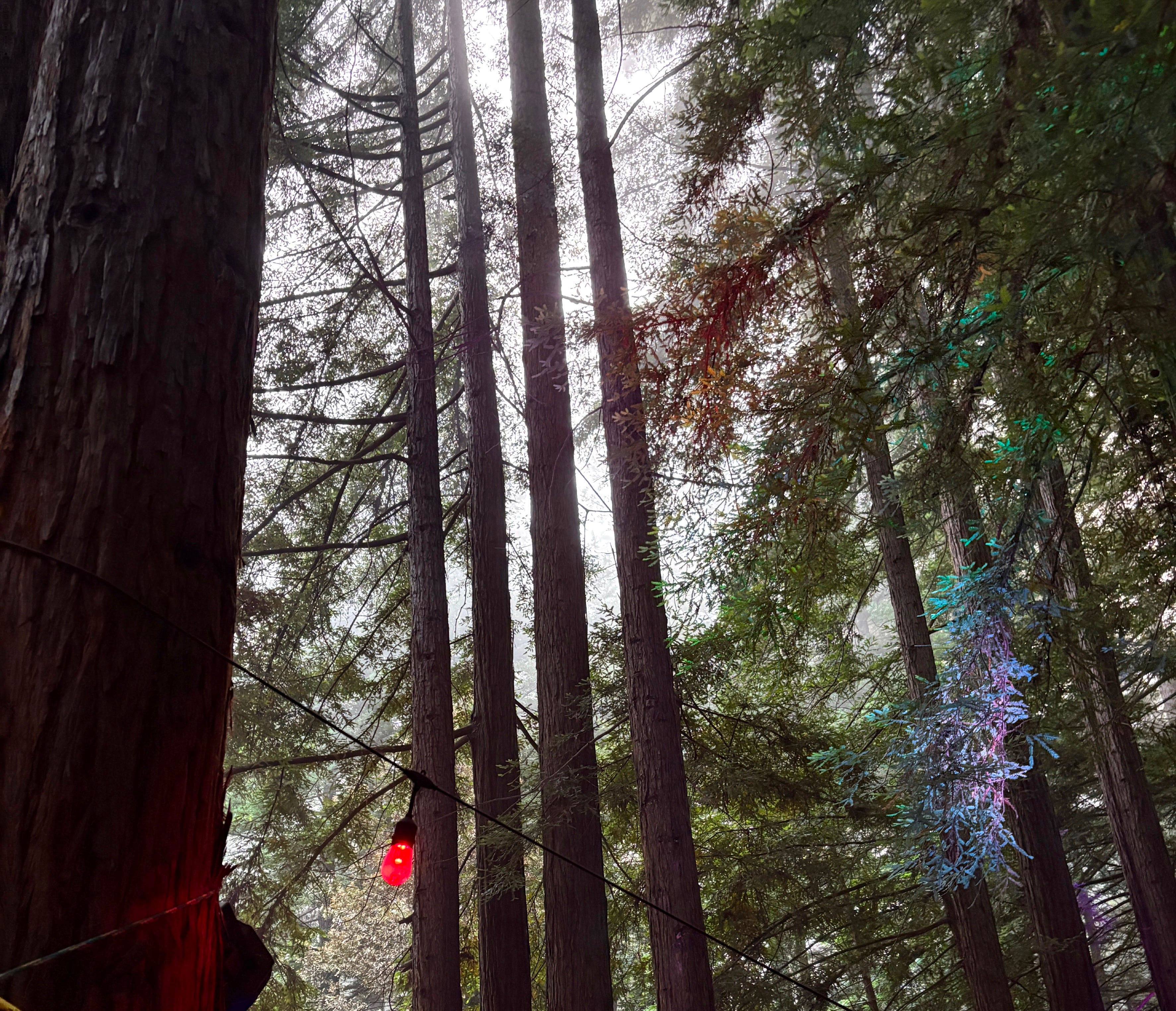
Earlier this month, I found myself amongst the breathtaking trees of the Redwoods in Northern California. Laying in an elevated hammock with dear friends and lovers, I watched the forest slowly illuminate this beautiful cluster of four sister trees, mirroring us. A metaphor for trees growing near each other and attachment theory suddenly clicked—these interdependent trees were supporting one another’s growth while staying firmly rooted. Expanding this metaphor, I reflected on the Redwood forest, an interconnected network of trees exchanging nutrients and information, as a powerful example of communal secure attachment—the collective manifestation of multiple secure connection constellations creating positive and sustainable feedbacks loop of attuned attachment, holding space for simultaneous emotional regulation and presence.
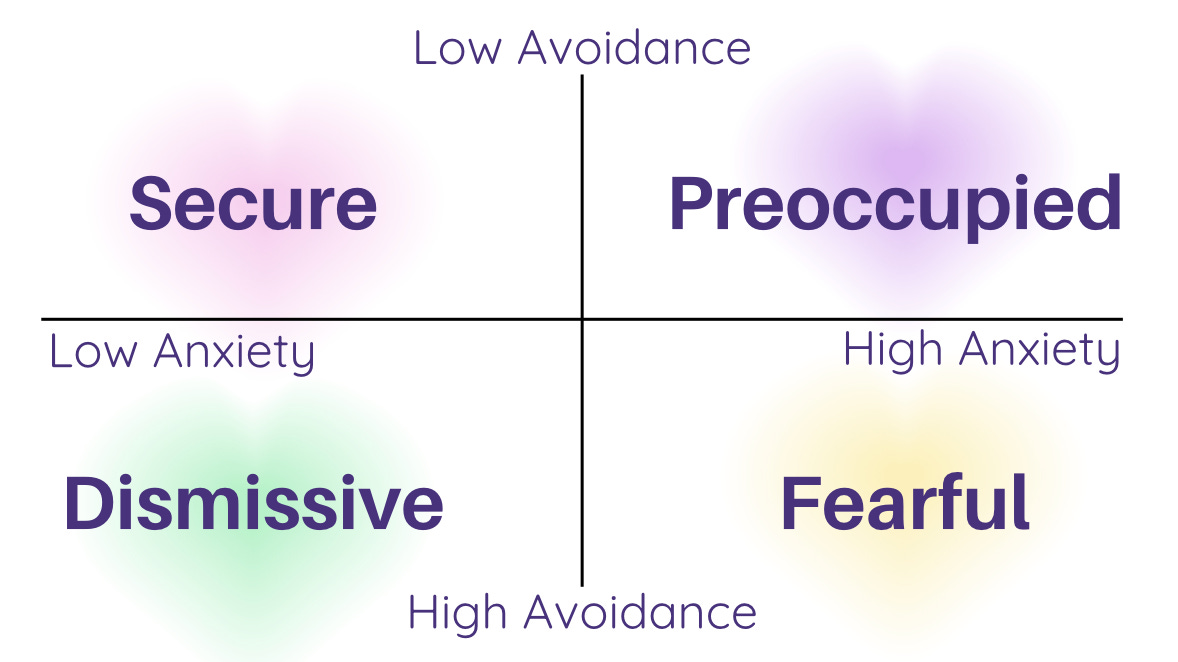
from Polywise by Jessica Fern & David Cooley
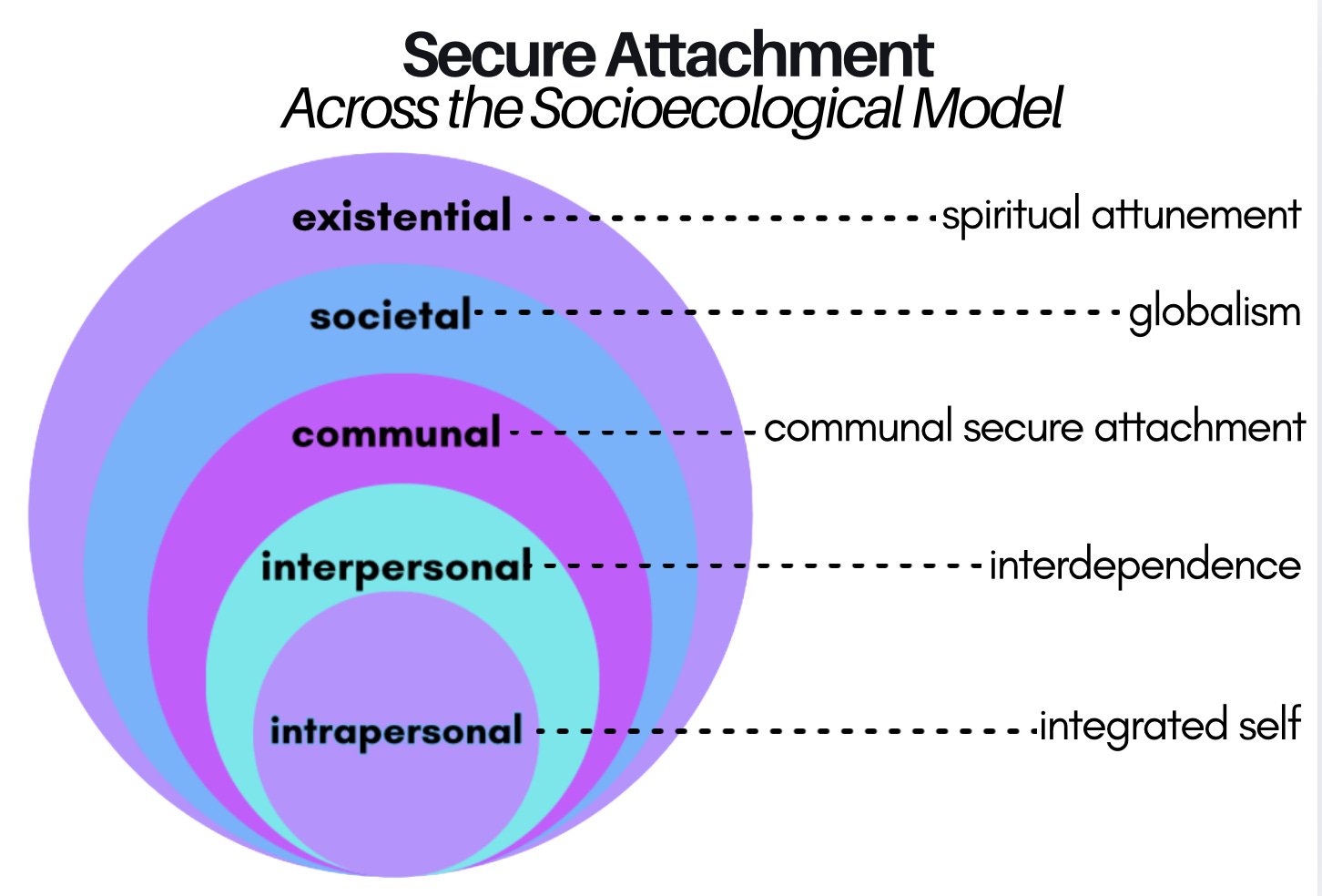
My introduction to attachment theory included, Attached: The New Science of Adult Attachment and How It Can Help You Find--and Keep--Love, By Amir Levine/Rachel Heller, which provided a foundation for other texts like Healing the Fragmented Selves of Trauma Survivors" by Janina Fisher and Polysecure, as well as Polywise, by Jessica Fern (and David Cooley). Through these texts, I learned that attachment theory is shaped not only by our first five years of life, but throughout our life-spans, including multiple types of relationship (friend, sibling etc), beyond romantic partners or parental figures. I went from feelings of shame around the anxious attachment I had contended with most of my life, to being able to extend gratitude to the parts of me working to get our needs met in environments with scarcity around attachment resources—attunement, presence, and reliable care. As Janina Fisher states, “If the brain and the body are inherently adaptive, then the legacy of trauma responses must also reflect an attempt at adaptation, rather than evidence of pathology.” Taking this lens, informed by the Sufi poet, Rumi, and You Are The One You’ve Been Waiting For: Applying Internal Family Systems to Intimate Relationships by Richard C. Schwartz, allowed me to realize the areas where I had been internalizing the shortcomings of environments I did not consent to be in, as my own inadequacy. The quote, “we choose attachment over authenticity,” brought me clarity and relief as I realized I hadn’t had access to attachment systems where I could be authentic and unconditionally loved simultaneously. As a 1.5 generation, queer and non-monogamous Egyptian American who grew up between New York City and Iowa, integrating my authentic sense of self and finding community has been a life-long journey and often times, a struggle. I was relieved to discover that taking a systems level approach to understanding attachment theory provided a more comprehensive, and therefore accurate data set. As someone who historically hated being alone for most of my life, cycling through multiple codependent and abusive relationships, I was also surprised to learn intrapersonal, or self-secure attachment, was another layer that I had agency over as my own primary caretaker. The resources I sought out to support with my polyamory journey began to have much further reaching implications alongside the dismantling of hierarchy of sexual and romantic relationships as more important than friendship, as we are socialized in multiple cultural contexts.
As I read Polysecure while I was in Egypt, I realized that I was in between two communal attachment extremes—the avoidantly attached, hyper individualism/capitalism, and anxiously attached/co-dependent/gift economy. Zooming out through an adaptive lens, it became more clear that if attachment style on the level of an individual is an adaptive response to the interpersonal environment, attachment style networks on the level of a community are an adaptive response to their societal environment. I realized that my healing journey has mapped onto the development of secure attachment with myself, interpersonally, communally, and even existentially through intentional psychedelic experiences within a healthy attachment environment. As I questioned why insecure attachment across the socioecological model was the wide spread default, and how capitalism and colonialism benefit from disconnection, I remembered the wise words of a Sufi teacher: “systems of oppression benefit from divisiveness on every level.” I strongly believe that understanding what we don’t want is an integral step in the process in understanding what we do want, which allows us to direct our attention in growth oriented and possibilist ways (alternative to optimism & pessimism=possibilism-Hans Rosling). Below is a visual representation of Secure Attachment Across the Socioecological Model, which reflects how systems of liberation benefit from unity on every level.
Before I started queering existentialism, existential dread consumed me as I struggled to sustainably find community, filled with cynicism around connection and working to make systems level changes from within academic and governmental institutions. The mission statement of queering existentialism is “to co-create containers for the exchange of liberating ideas and the cultivation of communal secure attachment, a concept that I have developed over years of lived experience, research, and experimentation.
As someone who has grappled with depression, anxiety, C-PTSD, abusive relationships, neurodivergence, eating disorders, generational trauma, self-harm, suicidal ideation etc., my special interest in mental health over the last decade has been rooted in a deeply personal desire to understand and alleviate the burdensome impact of this long time reality. My lowest mental health point in January of 2022 ended up creating the conditions that would lead me to where I am now over three years later—in a place of healing, relief, gratitude, emotional stability and sustainable joy. I acknowledge the different privileges I hold that facilitated this process, while aspiring to share my personal story, resources that transformed my understanding of healing, and the ways I have been working towards increasing accessibility and awareness of these resources.
In 2022, I revisited one of the most impactful books I have have ever read—*Lost Connections: Uncovering the Real Causes of Depression —and the Unexpected Solutions,* and decided to create an intervention for myself based on the books. Like the author, Johann Hari, anti-depressants hadn't been effective for me, and I craved an upstream (following the root of the root cause) intervention. The research-based approach intertwined with lived experience provided a grounding and comforting framework that I realized I could translate into an intervention for myself. For each of the nine causes of depression and anxiety, there was a solution based in reconnection—to other people, to social prescribing (shared, meaningful activities with a consistent group), to meaningful work, to meaningful values, to sympathetic joy/overcoming addiction to self, to acknowledging/overcoming childhood trauma, and to restoring the future.
I will soon be sharing the intervention guide I developed, and how I translated these concepts to practical and actionable steps, as a foundation for a guide that others can experiment with and apply to their own lives. I didn’t realize at the time, but these concepts would go on to deeply inform communal secure attachment and the community organizing that would transform my life. Now, my connection to other people is rooted in shared meaningful values and co-creating meaningful work together. I have worked through suppressed childhood and ancestral trauma through intentionally engaging with altered states, oftentimes stigmatized pathways to healing. I believe in restoring the future through finding areas of agency and possibility through a relational, rather punitive, frameworks.
The journey of developing secure attachment to myself has been theoretically informed through the combination of frameworks such as internal family systems (IFS), unlearning mononormativity (a set of beliefs around love that reinforces co-dependence and disconnection from self & community), and somatically informed by experiences with altered states and movement. However, this journey has been inextricably linked with experiencing the powerful therapeutic potentiality of communal secure attachment. Finding securely attached communities reinforced the secure interpersonal and intrapersonal connections I was finally able to form—I couldn’t grow, root and heal on my own. The hyperindividualist approach to mental health, stopping at individual therapy or pharmaceutical intervention, had never worked for me. This path of researching, experimenting, and finding community—not just any community—but securely attached community, led me to realizing the critical role of communal secure attachment as the mental health intervention that I had been searching for.
I began to wonder what made these securely-attached communities different than other ones I had encountered. What skills would be needed to cultivate and spread this approach to relating? What are the behaviors of individuals in this type of relational system? How do we collectively unlearn the manifestations of oppressive systems on every level, and how can these ideas be communicated in a way that calls people in? How do we co-create networks of generosity and abundance, where secure attachment on each level becomes adaptive within the micro and macro level it is nested within?
These are some of the questions I have been exploring through writing, workshops and events over the last (almost) two years. I spent years looking for a third space that integrated vulnerability, care, critical thinking, education and values, outside of clinical/institutional settings, and realized I had to create it. This would not have been possible without finding collaborators along the way who share that vision, and it has truly been a transformational journey.
I recently left my day job to fully focus on queering existentialism and related projects, and am building out a Patreon with a library of resources and opportunities to support the sustainability of this work. I will continue to expand on these concepts, my story, and practical and accessible ways to implement liberating ideas, collectively. This work has given me hope as we not only navigate the collapse of oppressive systems, but actively co-create liberating ones, together.
💖✨️
Yes!!! You might be interested in Kinship Ecologies (very similar wisdom). Thanks for writing this. It’s brilliant and spot on.